CarbonBudget – a data-driven tool for the building sector’s path to net zero
The construction industry is responsible for around one-third of global CO₂ emissions. Architects therefore have a significant responsibility toward society. Their design decisions determine the carbon footprint of buildings and, in turn, their impact on the global climate. To avoid exceeding the planet’s ecological limits in the long term, the industry must transform. The Paris Agreement provides a clear point of reference for this transition: it aims to limit global warming to as close to 1.5°C above pre-industrial levels as possible.
Against this backdrop, we set out to answer a central question: How can these abstract limits be translated into actionable data for individual buildings? Put differently, how can a CO₂ budget for specific architectural projects be determined?
Assessing emissions across a building’s entire life cycle is now an established practice. A life cycle assessment (LCA) accounts for the materials and resources used in construction, as well as the building’s operation and eventual demolition. Until now, however, there has been no framework for putting the calculated CO₂ value into context. Is a building’s carbon footprint high or low? And how does a building’s intended use affect this assessment? Technology-intensive buildings such as hospitals and laboratories naturally require more energy than offices, for example.
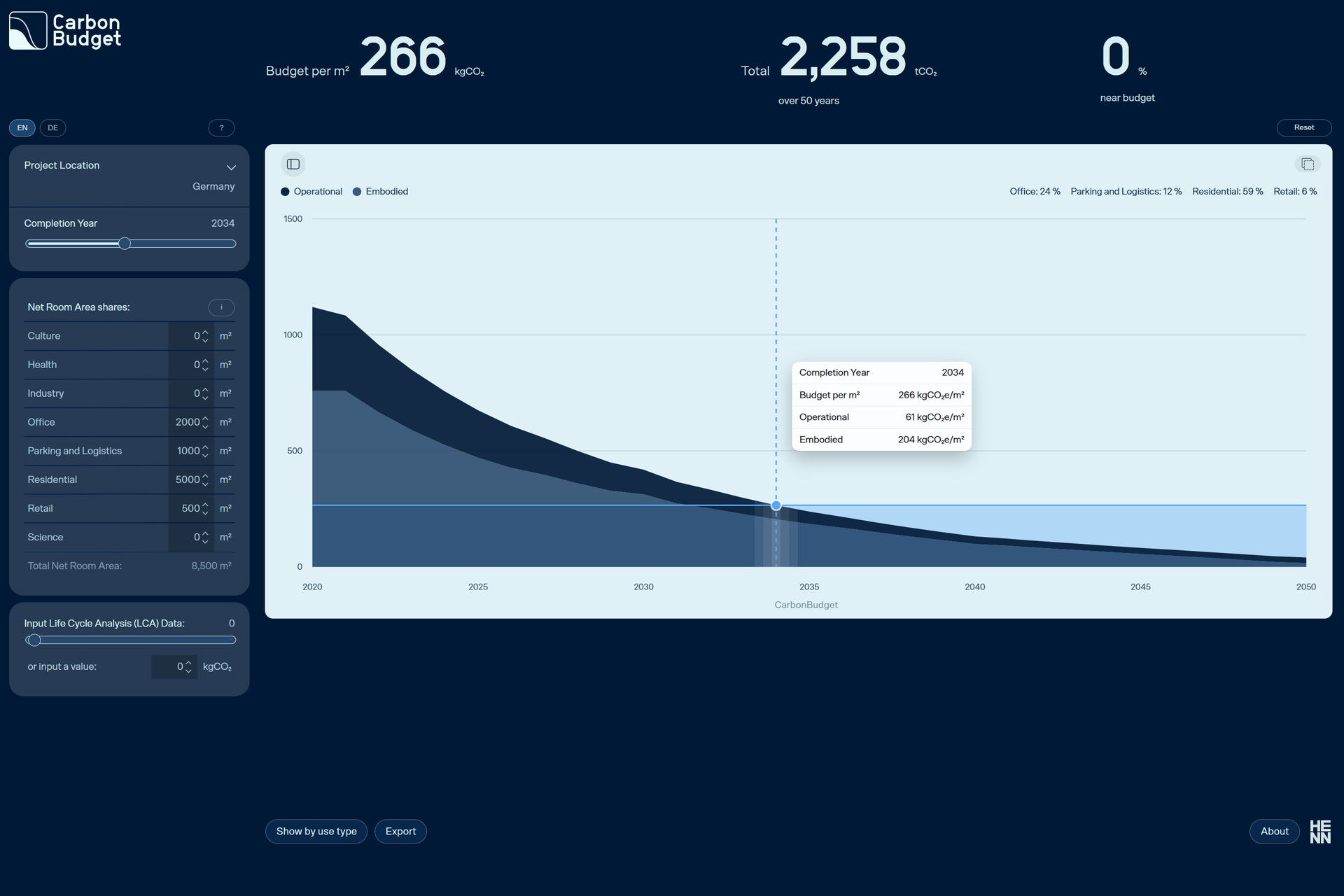
To calculate such project-specific budgets and provide a reliable framework for assessing them, our sustainability team developed a digital tool. Based on just a few inputs, including location, year of completion, and building area, CarbonBudget determines whether the emissions of a building project located in Europe are compatible with the 1.5°C target. For existing LCA values, the tool visualizes whether emissions fall within or outside the allocated CO₂ budget.
Science-based approach
CarbonBudget was developed within HENN’s own architectural practice and is based on recognized scientific decarbonization pathways. It integrates data from the Science Based Targets initiative (SBTi) and the Carbon Risk Real Estate Monitor (CRREM), while taking into account the ongoing decarbonization of European electricity grids. The result is an approach that is comparable, robust, and consistent with European climate targets.
Well-informed decisions early on
CarbonBudget shows different design decisions perform against a 1.5 °C pathway. This enables architects, engineers, developers, researchers, and policymakers to quickly understand the climate boundaries of their projects and make informed decisions from the start.
Empowering sustainable design
HENN provides CarbonBudget free of charge for professional and commercial use. In doing so, the firm aims to contribute to transparent, responsible, and climate-conscious CO₂ management in architecture and across the entire construction sector.